
We are now four weeks into sheltering-in-place, social (physical) distancing, Zoom gatherings, and over-consumption of toilet paper, sanitizers and wine. We are bored, afraid, lonely and just want this COVID-19 pandemic mess to be over. We want a return to normalcy. But when will that happen and what will it look like? How will we be changed by it? Will we be left better or worse off? Will there be structural changes to our culture, our political system, our workplaces and our economy?
Clearly we are not there yet. As of April 16, 2020:
- 2 million COVID-19 coronavirus cases worldwide, 31,000 deaths
- 654,300 cases in U.S., 32,000 deaths
- 1,447 cases in KC metro, 76 deaths
- Kansas statewide COVID-19 stay-at-home order extended to May 3, KCMO’s to May 15
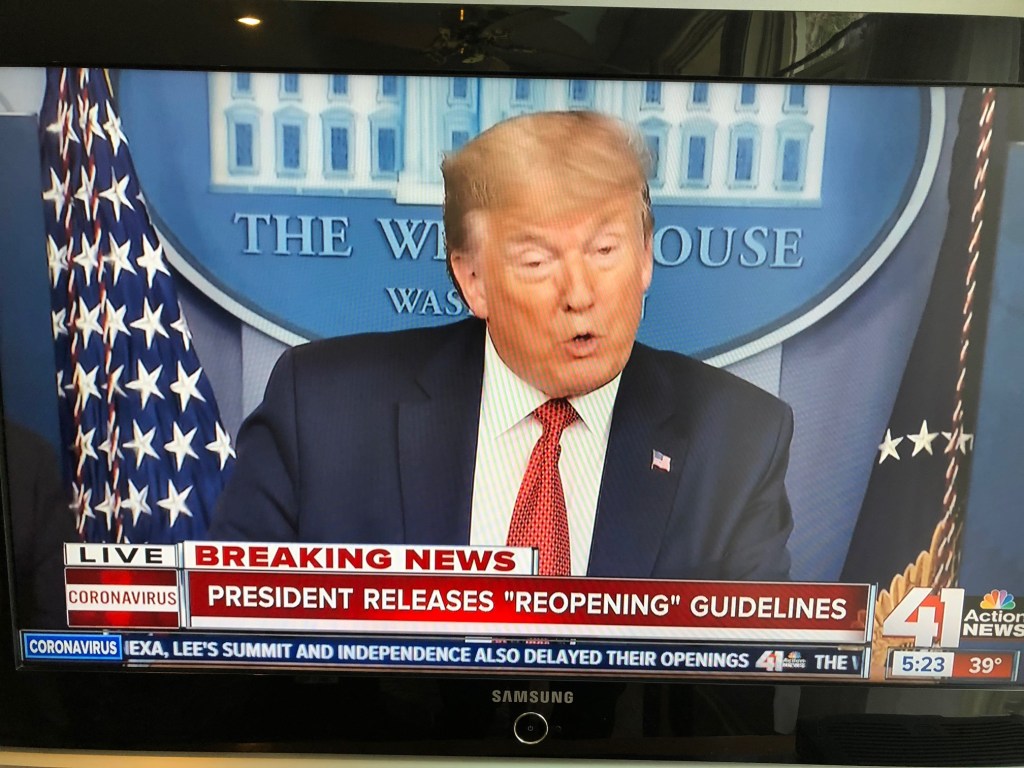
Opinions vary wildly as to when we will be back to normal. The presidential task force recommended to the states a three-stage protocol for relaxing restrictions. It is constitutionally up to the states to implement as each sees appropriate. Some authorities believe the worst days of COVID-19 are behind us and forecast brighter days ahead. Others believe additional waves are rolling toward us and “coming out on the other side” is still months, if not more than a year away. Lots of experts are weighing in on the questions confronting this unique moment in history. I am not one of them. Nonetheless, below are a dozen personal observations of what might happen, with two disclaimers: 1) I have no expertise on any of these issues; 2) I earned my D in Econ 101.
We will know a lot more about COVID-19 – for sure. We started behind the curve on this pandemic – unprecedented in scope and scale of any in our lifetime – and have yet to catch up. Epidemiologists and scientists are working furiously to understand the complexities of this virus. Medical professionals are working valiantly in caring for victims. No doubt their efforts will bear fruit once testing is fully implemented and they have sufficient data. Citizen volunteers have inspired. We are encouraged that pharmaceutical companies are working collaboratively to find a vaccine. We will learn from our failures, of which there are many, and be better prepared the next time COVID-19 or another global virus hits our shores.

We will become a less polarized society – at least for a while. This may be an out-on-a-limb view, but think about it: We as a society haven’t been this united in common fear, sacrifice and suffering since World War II. COVID-19 is an equal opportunity scourge. It can affect any one of us regardless of station in life or privilege. Maybe this would be a good time to seriously discuss compulsory service, be it military, social or other government paid service.
We will be more grateful and humble– temporarily. We’ve received our “comeuppance” and learned that no matter how accomplished we are, we have vulnerability. We are humbled by the emergence of new kinds of heroes – the doctors and nurses who are showing so much courage in this battle to be sure. But less likely first responders stand among us as well – hospital orderlies, grocery store (and liquor store) checkers and stockers, gas station operators, drivers of delivery vehicles and caring neighbors. And, perhaps most of all, teachers have risen in our collective esteem. As every parent and grandparent of an elementary school child knows now more than ever, teachers have a really tough, important job. They don’t get enough credit or pay.
We will have a heightened sense of community – for a minute, hopefully longer. Sheltering in place and working from home have given us a chance to meet our neighbors like never before. But it’s springtime. The temps and seemingly clearer air thanks to suddenly fewer carbon emissions give us an en excuse to go outside. We have to get out and we should get out for our own wellbeing. The neighborliness, as we walk around the block greeting passing acquaintances and heretofore strangers, feels good. Hopefully, impromptu driveway gatherings will become a permanent thing – absent the six-feet rule.
We will be more technologically literate and less secure for it – for sure. We are downloading more apps, finding more ways to communicate with our families, friends, colleagues, clients and congregants, be entertained, and using telemedicine (or none at all). We are seeing the value of tracking the spread and virulence of coronavirus, providing information and insights into this confounding disease to protect us. These are all good things. But…and you knew it was coming: the technology comes with great risk. Like the implementation of security measures adopted in the wake of 911, we are giving up privacy that can be exploited in harmful ways we never saw coming. Most of us are vulnerable because we either don’t understand how data collection/mining works, or we are trusting of our children or friends who “seem techy,” but lack real understanding as to how rapidly developing technologies work. So not only is our privacy at greater risk, but our personal security as well. Regulations will be relaxed in the name of national security and welfare of citizens, exacerbating the problem.
The workplace will be changed forever – unquestionably. Businesses have learned what solopreneurs and gig workers learned long ago – that working from home can be far more productive than working in a traditional office setting. It can also be more satisfying; especially for certain personality types who function better in more introspective spaces. And it will be a godsend to working parents with sick children. The new normal will definitely include a much larger workforce working remotely than at any point since the industrial revolution. Thriving businesses will no longer need to take on more expensive real estate to accommodate employees. Successful companies and new entrepreneurs will be nimbler, more responsive to shifting paradigms. They will figure out the most efficient ways to deploy their workers and create an invigorated culture. And, as is ever the case, there will be significant winners and losers in the transformation.
Government will be bigger– for the foreseeable future. We’ve taken on a ton of national debt on top of a ton of debt. The 2+ trillion dollars has already proved insufficient and the distribution of the funds a fiasco. In addition, we are facing huge global issues: climate change related events, worldwide economic deficiencies, geopolitical strife, tenuous trade and defense alliances, income inequality and scarcity of essentials. Nationally, the crisis has shined the spotlight glaringly on our inadequate health care system and that weakened bureaucracies must be improved. And as potent and innovative as American business is, the private sector simply doesn’t have the economic horsepower to be the answer. Only government, with its ability to print money and right itself can “establish justice, insure domestic tranquility provide for the common defense, promote the general welfare and secure the blessings of liberty to ourselves and our posterity.”
The economy will prove more resilient than it appears now – we can only hope. As devastating as this pandemic shutdown has been for businesses and individuals thrown out of work, most economists agree the underlying economic fundamentals before COVID-19 were pretty solid. To be sure, many local businesses and some struggling corporate giants will fail and never come back. But many employees in the service industry and even manufacturing sectors will be re-hired by their former employers or emerging start-ups. People who have remained employed may have lost substantial nest egg money, but still have substantial income with limited places to spend it. The pent-up demand for spending on dining, travel, entertainment and shopping will be tremendous.
There will be a political realignment – most likely. Political scientists generally agree that there have been five major political realignments (times in which a particular party either arose and dominated for a period of time or dissolved) and several lesser ones in which power abruptly shifted from one to another. The last of the major realignments came with the FDR New Deal Democrats. While it is unclear which of the current major parties will triumph, a tea-leaves reader may reasonably make the case that one will go away entirely (at least for practical purposes), leaving the other to evolve in some way (as it must) and thereby assume dominant power for at least the next decade or so.
Critical thinking will re-emerge – maybe. In the late 18thcentury, philosophers like Locke, Hobbes and Montesquieu planted Enlightenment seeds left over from the Dark Ages-to-Renaissance periods, thus paving the way for a new era of reason that produced political and industrial revolution that gave birth to democracy and economic progress in the U.S., France and elsewhere. For several decades, technology and STEM/practical education have advanced. Meanwhile, as the study of arts/humanities has been back-burnered, critical thinking has devolved. Seeds of reason and rationality are beginning to burst forth in the form of books like “Range” that posits eventual specialists are served better by a broad range of experience early in life. Creative and critical thinking will be essential to successfully confronting the serious crises of our time. As we collectively wrestle with Constitutional issues and examine the foundation of our democratic republic, we will see that our institutions are surprisingly sound. We can and should rid ourselves of antiquated laws and make new ones that fit where we are today. But that’s the elegant beauty of our Constitution. We still have a long way to go in establishing the more perfect union that our founders wrote into the Preamble.
We will come out on the other side of pandemic for the better– mostly. Sadly, the number of personal tragedies will be tremendous, make no mistake about it. Untold thousands of lives will be lost to the disease causing untold grief to their families, friends and dependents. There will be collateral economic damage from which a good many will never recover. We all grieve for their situation. We as individuals and as society will do our best to fill in the gaps for those left behind, so I hope, perhaps more than I believe. But many more thousands and millions will demonstrate the resilience that characterized the greatest generation that suffered through pandemics of their era, the Great Depression that lasted more than a decade and World War II. As a side note, my 99-year-old mother does not believe her generation was the greatest generation. “We just did what we had to do in the times we were given,” she says. A rising multi-generational cohort will step up and transform our country in ways we boomers aspired to do, but never quite succeeded. The next decade or so will prove interesting and challenging. I can’t wait to see the world my children, grandchildren and their peers create. Really can’t wait to be with family and friends, go to sporting events and out to eat or a movie, run a footrace and generally enjoy complete freedom.
 The Nontrepreneur